100 Famous Castles of Japan Stamp Rally
Keep a record of this trip
Sign up free100 Famous Castles of Japan Stamp Rally

A list of the 'New 100 Famous Castles of Japan' (No. 101-200), selected by the Japan Castle Foundation in 2017 and implemented as a stamp rally since 2018, organized by region. This list covers famous castles and castle ruins nationwide, from Hokkaido to Okinawa, including magnificent castles with stone walls and keeps like Yonago Castle, Nakao Castle, and Gujohachiman Castle, to ancient castles and fortifications such as Shinagawa Daiba, Mizuki, Kii Castle, Kaneda Castle, and Kikuchi Castle, and even World Heritage sites like Zakimi Castle, Katsuren Castle, and Hara Castle. This is the second series following the '100 Famous Castles of Japan,' focusing on remains like stone walls, earthworks, and enclosures, as well as reconstructed or mock keeps, and Gusuku and ancient mountain castles, as there are no existing keeps. Stamps for each castle are located at management offices, museums, or castle entrances, but their locations, hours, and fees may change, so always check the official sources (Japan Castle Foundation / each castle) for the latest information. You can view all 100 castles on a map and record how many you have conquered by checking in.
1. Hokkaido/Tohoku
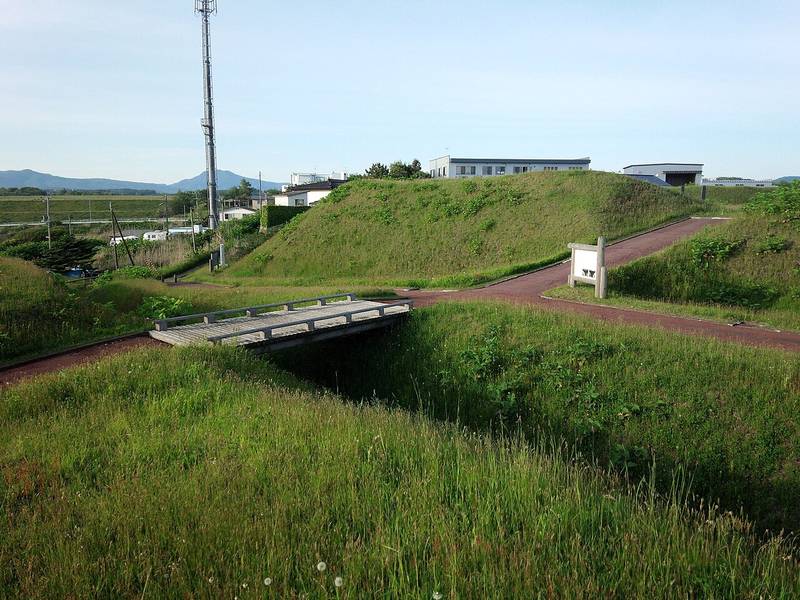
A medieval castle site, counted as one of the Dōnan Jūni-kan. It lacks a keep, but a nearly rectangular layout with earthworks and a 'yakken-bori' (V-shaped dry moat) remains on a coastal terrace, offering views of the Tsugaru Strait and Mt. Hakodate. Designated a National Historic Site in 1934. Stamps are located near the azumaya (rest shelter) within the historic site (check official sources for locations and hours). Approximately a 5-minute walk from the Shikode bus stop.

A mountain castle from the medieval period, serving as the base of the Kakizaki clan (later Matsumae clan) on the mid-slope of Mt. Iō. It does not have a keep. Enclosures, the site of Yahata Hachiman Shrine, and the Iōyama burial mounds remain, with numerous artifacts known to have been excavated. Designated a National Historic Site as 'Katsuyamakanato Ruins' in 1977. Stamps are located near the Katsuyamakanato Ruins Guidance Facility (the facility is closed in winter; check official sources for locations and hours). Approximately a 30-minute walk from the 'Harauta' bus stop.
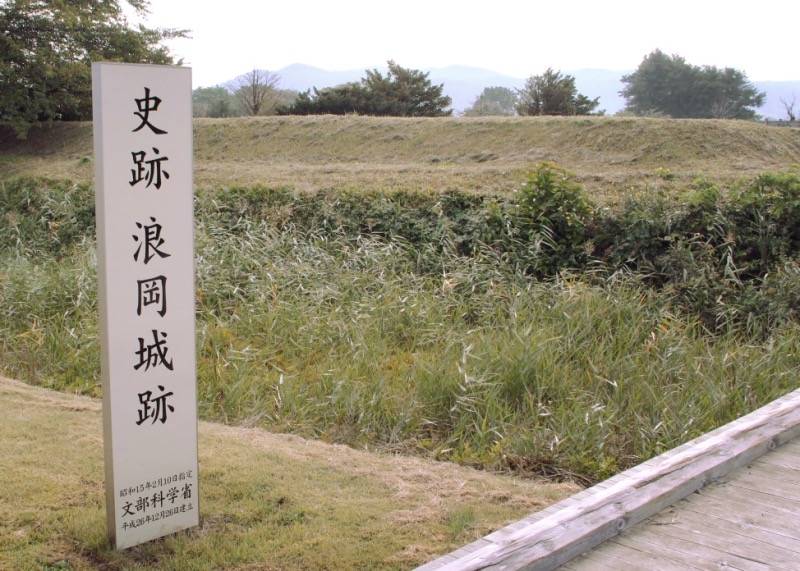
A medieval hillside castle ruins believed to have been built by the Namioka Kitabatake clan. It lacks a keep, and the layout, with multiple enclosures (kan) like the Uchiyashiki and Kitayashiki divided by earthworks and moats, remains. It was the first site in Aomori Prefecture to be designated a National Historic Site in 1940. Excavated items are exhibited at the adjacent 'Aomori City Medieval Museum.' Stamps are located near the Aomori City Medieval Museum (check official sources for locations and hours). Approximately a 15-minute walk from JR Ou Main Line Namioka Station.
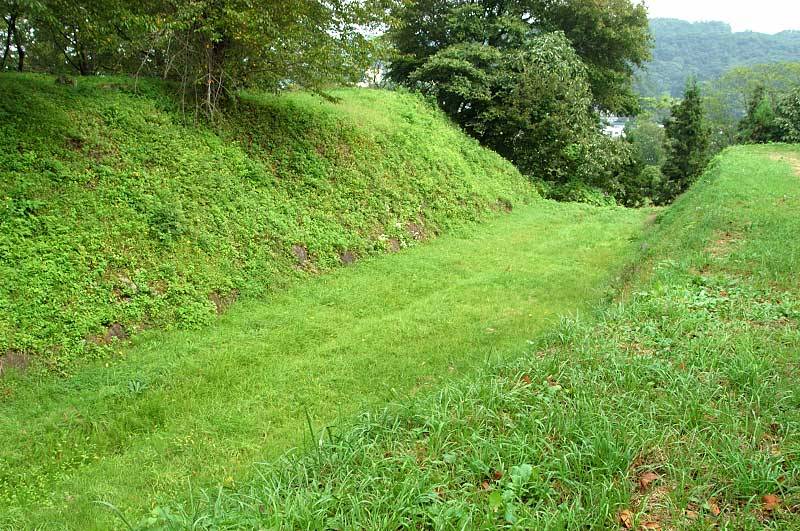
A tiered flat-mountain castle ruins built by the Kunohe clan, lacking a keep. Known as the site of the Kunohe Masazane Rebellion (1591), it retains some of the oldest stone walls in Tohoku, dating from the repairs by Gamo Ujisato and others after the rebellion, as well as deep dry moats and earthworks. Designated a National Historic Site in 1935. Stamps are located near the Kunohe Castle Guide House and the Ninohe City Buried Cultural Properties Center (check official sources for locations and hours). The nearest station is Ninohe Station.
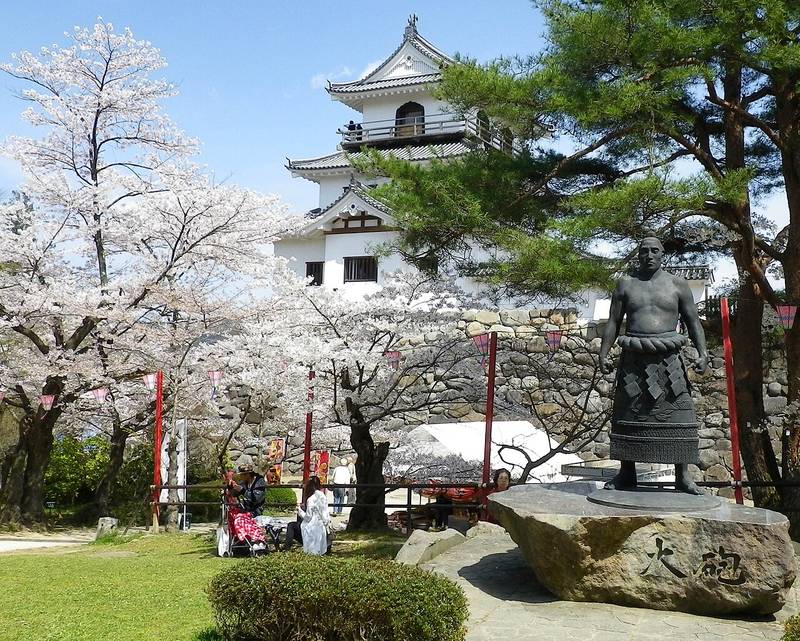
The residence of the Katakura clan, a senior retainer of the Date clan of Sendai Domain, it survived as a branch castle until the Meiji era after the 'One Castle per Province' decree. The three-story yagura, equivalent to a keep, is not an existing structure but was faithfully reconstructed in wood using traditional methods in 1995. It is preserved along with the Otemon gate and earth walls on the main bailey site. Designated a historic site by Shiroishi City. Stamps are located inside the Shiraishi Castle keep (Sangen-yagura) (during opening hours, check official sources). Approximately a 15-minute walk from JR Shiroishi Station.
A medieval mountain castle ruins extensively developed by Sukeaki Ando (Akita clan). It lacks a keep, but enclosures, earthworks, dry moats, and well sites spread across the hills, offering panoramic views of the Sea of Japan and the Oga Peninsula. Designated a National Historic Site in 2004. Stamps are located at the Wakimoto Castle Ruins Information Center (relocated to Michi-no-Eki Oga etc. in winter; check official sources for locations and hours). Approximately a 35-minute walk from JR Oga Line Wakimoto Station.
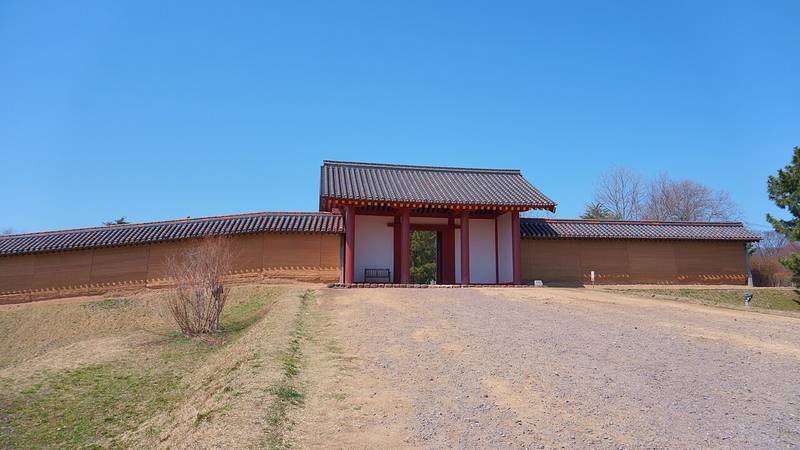
An ancient castle-town from the Nara period, not a castle from the early modern period. It was built in 733 AD as Dewa-no-kōri and later renamed Akita Castle, serving as an administrative and military base. The outer wall's East Gate, earthen walls, and ancient latrines have been restored, and excavated items are exhibited at the adjacent Historical Museum. Designated a National Historic Site in 1939. Stamps are located at the Akita Castle Ruins Historical Museum and the Historic Site Park Management Building (check official sources for locations and hours). Bus from JR Akita Station.
A ring-shaped flat castle ruins where the Sakai clan, lords of the Shonai Domain, ruled for approximately 250 years. It is now Tsuruoka Park. No keep was built; corner turrets served as substitutes. Although much was lost during the castle's demolition in the Meiji era, parts of the earthworks and water moats remain, and the Shonai Shrine, dedicated to the Sakai family, stands on the main bailey site. The Chido Museum and the National Historic Site of the domain school, Chido-kan, are also nearby. Stamps are located near the Shonai Shrine office (check official sources for hours). Approximately a 10-minute bus ride from JR Tsuruoka Station.
A ring-shaped flat castle ruins that served as the Uesugi clan's residence throughout the Edo period, now Matsugasaki Park. No keep was built; two three-story yaguras in the main bailey served as substitutes. It features earthworks with few stone walls and water moats. Uesugi Shrine, dedicated to Kenshin Uesugi and others, stands on the main bailey site, and the adjacent Uesugi Museum exhibits treasures. Stamps are located near the tourist information center within the Uesugi Shrine grounds (check official sources for locations and hours). Approximately a 10-minute bus ride from JR Yonezawa Station.
A mountain castle ruins that was the base of the Sengoku-period Tamura clan and later the residence of the Akita clan (55,000 koku) in the Edo period (also known as Maizuru Castle). It lacked a keep, and a three-story yagura at the western end of the main bailey was its symbol. After its demolition in the Meiji era, it was developed into a park, retaining vertical moats, earthworks, cut-offs, and enclosures, overlooking the townscape. Designated a historic site by Miharu Town. Stamps are located in two places: near the main bailey and at the Miharu Town History and Folklore Museum (check official sources for locations and hours). JR Ban'etsu East Line Miharu Station is the base.

A mountain castle ruins, said to be one of the largest in Japan, built by Morio Ashina during the Eiroku era. It lacks a keep and is now developed as Hakuhōzan Park, retaining enclosures, earthworks, vertical moats, entrances, and stone walls, with views of Mt. Bandai and the Aizu Basin. It was later used by the Uesugi and Gamo clans. Designated a National Historic Site in 2001. Stamps are located near the Mukaihaguro Gallery (restoration materials room) (the room has limited opening days; check official sources for locations and hours). JR Tadami Line Aizu-Hongō Station is the base.
2. Kanto
A rare authentic mountain castle in the Kanto region. No keep remains on site, but stone walls, moats, and earthworks are preserved. The Hachiman-dai turret was moved to Shinjo-ji Temple in the city and still exists, and a castle gate remains in a private residence. It was built by Tokiomo Kasama in the Kamakura period and later renovated into a Toyotomi-style castle by Goshige Gamo. The relocated turret is an Ibaraki Prefecture Cultural Property. The Sasagami Shrine is located on the keep base, and the foot of the mountain is developed as Sabakiyama Foot Park. The stamp is located near the site (confirm official sources for location and stamping hours). By bus from JR Mito Line Kasama Station.
A flatland castle with a concentric layout surrounded by a water moat, also known as Kame Castle (Turtle Castle). The Taiko Yagura Gate and Kasumi Gate of the Honmaru still exist, and the Higashi Yagura and Nishi Yagura are reconstructions made of wood (not existing castle keeps). Built in the Muromachi period, it was the residence of the Tsuchiya clan and others in the Edo period. Designated Historic Site of Ibaraki Prefecture. Highlights include the double moats, existing gates, and reconstructed turrets; the area is Kamejo Park. The stamp is located near the park (please confirm location and hours with official source). About a 15-minute walk from JR Joban Line Tsuchiura Station.
A ridge-connected mountain castle boasting rare high stone walls in the Kanto region. No buildings remain, but highlights include the remains of the main gate's masugata stone walls, earthworks, moats, and bridges. It is said to have been the residence of the Sano clan and repelled numerous attacks by Kenshin Uesugi. Designated a National Historic Site in 2014. Kitabatake Shrine stands on the Honmaru ruins, offering good views of the Kanto Plain. Stamps are available near the shrine (please confirm location and stamping hours with the official source). Accessible by foot from Tanuma Station on the Tobu Sano Line.
A multi-tiered mountain castle built on a cliff overlooking the Tone River. No buildings remain, but traces of enclosures, earthworks, crescent-shaped moats, and entrances are preserved. It was a key point for controlling the Numata territory, built by Masayuki Sanada in 1579 under the orders of Katsuyori Takeda, and the Nukuri Castle Incident in 1589 became the trigger for Hideyoshi's Odawara Campaign. Designated a historic site by Gunma Prefecture. Structures like excavated pillar buildings have been restored and developed. Stamps are located near the site (check official sources for locations and hours). Taxi from JR Joetsu Line Gochō Station.
A castle built on a river terrace. Nobuyuki Sanada built a five-story keep, but it was demolished during the Edo period and no longer exists. The castle gate was moved to Kawaba Village and still exists, and a bell tower has been restored on the main keep site. After being built by Akitsugu Numata, it became the residence of five generations of the Sanada clan. It is a Numata City Historic Site. Stone walls, earthworks, and moats remain, and the area is Numata Park, a famous cherry blossom spot. The stamp is located near the park (confirm official sources for location and stamping hours). Approximately a 15-minute walk from JR Joetsu Line Numata Station.
A mountain castle built on the middle slope of Mt. Iwagai; there are no buildings, but remnants of the Honmaru ruins, enclosures, dry moats, and vertical moats remain. It is a castle associated with the Sanada clan, who resided there after the Saito clan, including Sanada Yukitaka, Masayuki, and Nobuyuki. Sanada Nobuyuki abandoned the castle in 1614. Designated a National Historic Site in 2019. Highlights include the view unique to a mountain castle and the hiking trails. The stamp is located near the tourist information center at the trailhead (please confirm location and hours with official source). JR Agatsuma Line Gunma-Haramachi Station is the base.

A flatland castle built by the Narita clan utilizing marshland, which served as the stage for the 'Nobou no Shiro' (The Lord of the Castle) that withstood Ishida Mitsunari's water siege. The Gosan-kai Yagura is an external reconstruction from 1988 made of reinforced concrete and is not historically accurate. It is a Prefectural Historic Site of Saitama. The earthworks of the Honmaru remain, and the interior of the yagura serves as the Gyoda City Folk Museum. Stamps are available near the museum (please confirm location and stamping hours with the official source). Approximately a 15-minute walk from Gyoda-shi Station on the Chichibu Railway.
A medieval mountain castle known as the "textbook of castle construction," where the layout of skillfully constructed enclosures, moats, earthworks, and gates, rather than buildings, is the main attraction. Excavation surveys suggest it was a castle from the Yamauchi-Uesugi氏 period. Designated a National Historic Site in 2008 as part of the "Hiki Castle and Residence Ruins Group" along with Sugaya-yakata Ruins, etc. It is renowned for the beauty of its medieval castle remains. The stamp is located near the Arashiyama Town Hall (confirm official sources for location and stamping hours). Accessible on foot from Musashi-Ranzan Station on the Tobu Tojo Line.
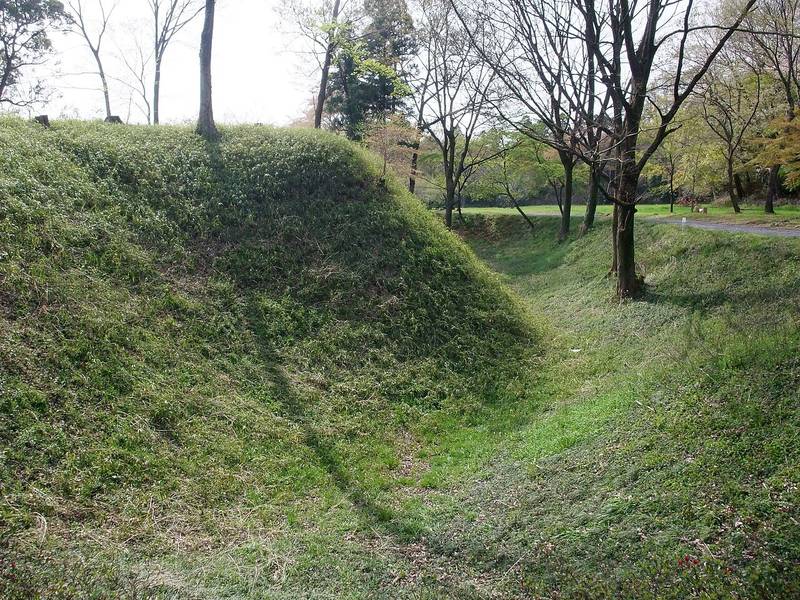
A flat castle (residence) said to be associated with the Kamakura retainer Tadashige Hatakeyama. No buildings remain, but the well-preserved earthworks, horizontal moats, and protruding枡形 (masugata) are highlights. It was later used by the Yamauchi-Uesugi clan and the Gohojo clan. Designated a National Historic Site in 2008 as part of the "Hiki Castle and Residence Ruins Group" along with Sugiyama Castle Ruins, etc. The Saitama Prefectural Museum of History is adjacent. The stamp is located near the museum (confirm official sources for location and stamping hours). Approximately a 13-minute walk from Musashi-Ranzan Station on the Tobu Tojo Line.
A flat-mountain castle with a concentric layout that served as the late base of the Shimousa Chiba clan. Although there are no buildings, the dry moats, earthworks, koguchi, and enclosures are almost completely intact, with excellent preservation of the remnants. Built by Chiba Suketane in the Bunmei era, it was later renovated by the Gohojo clan. In 1998, it was the first castle ruin in Chiba Prefecture to be designated a National Historic Site. Highlights include the earthworks such as the masugata koguchi. The stamp is located near the local information center (please confirm location and hours with official source). About a 10-minute walk from Keisei Main Line Daisakura Station.
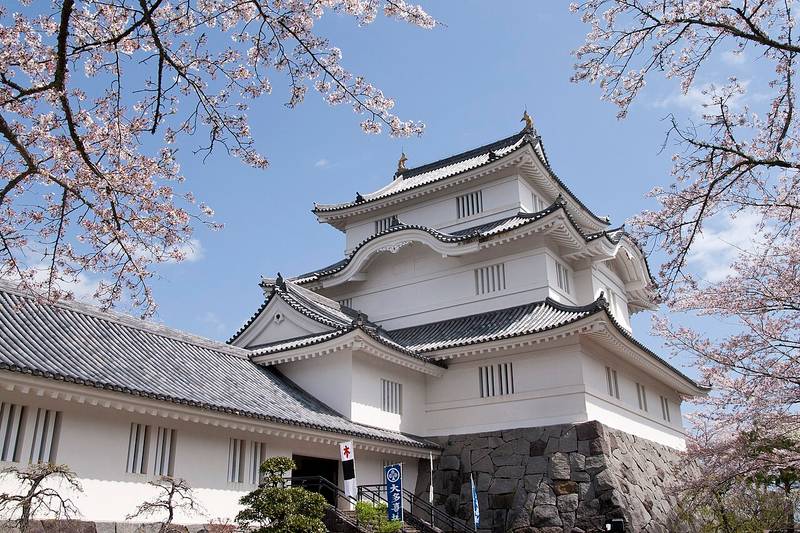
A flat-mountain castle with a concentric layout, extensively renovated by Honda Tadakatsu. The current three-story donjon is a 1975 reinforced concrete structure, a mock castle not based on historical appearance (not an existing donjon). After its construction by the Mariya clan, Honda Tadakatsu, a retainer of Tokugawa Ieyasu, became its lord. It is a Prefectural Historic Site of Chiba. Highlights include a well approximately 20 meters deep, earthworks, and a medicine gate. Stamps are available near the site (please confirm location and stamping hours with the official source). A walk from Otaki Station on the Isumi Railway.
A hillside castle with a continuous-style layout, extensively renovated by Ujiteru Hojo. It is an earthen castle with well-preserved dry moats, vertical moats, outworks,枡形 (masugata) gates, and earthworks, with no buildings remaining. After being built by the Oishi氏, Ujiteru Hojo made it his base, and it was attacked by Takeda Shingen's army. Designated a National Historic Site in 1951. Its skillfully designed defensive structures and cherry blossoms are highlights. The stamp is located near the site (confirm official sources for location and stamping hours). Accessible by bus from JR Hachioji Station, get off at "Takiyamajoshi-shita" and walk.
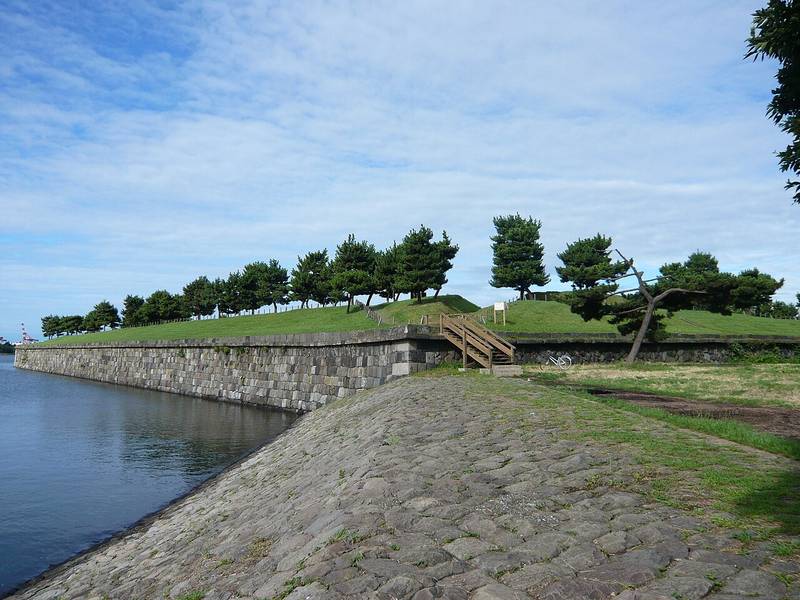
Western-style offshore batteries built in Tokyo Bay in response to Commodore Perry's arrival in the late Edo period; they are batteries, not castles. Currently, the Third Battery (opened as Daiba Park) and the uninhabited Sixth Battery still exist, with remains of stone walls and earthworks for the batteries. Built under the direction of Eitatsu Egawa, they were designated a National Historic Site in 1926 as "Shinagawa Daiba." The stamp is located near the site (confirm official sources for location and stamping hours). Accessible on foot from Odaiba-Kaihinkoen Station on the Yurikamome Line.
A flat-mountain castle with a concentric layout under the control of the Gohojo clan. There are no buildings, but it is a dirt castle with well-preserved remnants including dry moats with bends, earthworks, koguchi, and turret bases. It is also known as a castle attacked by Ota Dokan. Although not designated as a National, Prefectural, or City Historic Site, it is preserved as a Prefectural Special Greenery Conservation Area, and Yokohama City has developed it into "Koike Castle Site Citizens' Forest." Highlights include the bamboo forest and deep dry moats. The stamp is located near the site (please confirm location and hours with official source). Walk from JR Yokohama Line Koike Station.
A terraced mountain castle known as the 'One-Night Castle' built by Toyotomi Hideyoshi during the Odawara Campaign. It is considered the first castle in the Kanto region to be entirely constructed of stone walls. No buildings remain, but remnants such as the stone walls of the Honmaru, donjon base, and Inui-kuruma are preserved. Built in 1590. Designated a National Historic Site in 1959. Highlights include views overlooking Odawara Castle, and the entire area is Ishigakiyama Ichiyajo History Park. Stamps are available near the site (please confirm location and stamping hours with the official source). Accessible by foot or taxi from Hayakawa Station on the JR line.
3. Koshinetsu/Hokuriku
A castle built by Katsuyori Takeda in 1581. It is an unfortunate castle that Katsuyori himself burned down shortly after its completion before retreating. Only earthworks and dry moats remain, with no keep. The Takeda-style defensive facilities, such as the circular outwork, crescent-shaped moat, and枡形 (masugata) gate, are highlights. It is a National Historic Site. The stamp is located near the Nirasaki City Folklore Museum (confirm official sources for location and stamping hours). The nearest station is Shinfu Station on the JR Chuo Main Line.
A mountain castle built by Nobutora Takeda in 1520, said to be the birthplace of Shingen Takeda. There is no keep, but the remains of a medieval mountain castle, such as moats, vertical moats, enclosures, gates, and well sites, are well-preserved, and Anō-style stonework can also be seen. It is a National Historic Site. The stamp is located near the Kofu City Fujimura Memorial Hall (confirm official sources for location and stamping hours). Take a bus from Kofu Station North Exit and get off at Sekisuiji.
A star-shaped bastion fort built in 1864 by Matsudaira Noriyoshi of the Ogyu Matsudaira family during the late Edo period. It is one of only two pentagonal forts in Japan, along with Goryokaku in Hakodate. There is no castle keep, but the stone walls and moats remain, and the existing residence building is a highlight. National Historic Site. The stamp is located near the Ryuoka Castle Ruins Guidance Center. Please confirm the location and hours for stamping with the official source. JR Koumi Line Ryuokakou Station or Usuda Station.
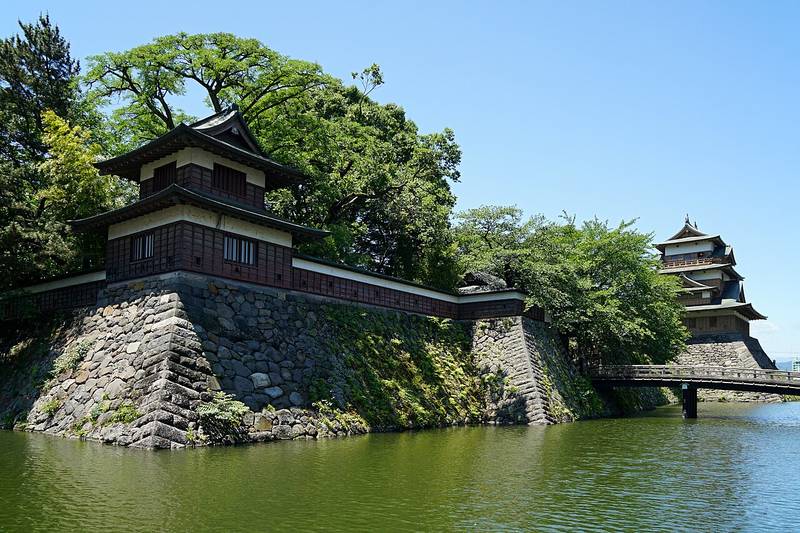
Built by Hine no Takayoshi during the Bunroku and Keicho eras, it was once a water castle protruding into Lake Suwa and was called the 'Floating Castle of Suwa.' It is one of Japan's three great lake castles. The original donjon was dismantled during the Meiji period, and the current donjon is a reconstruction from 1970 made of reinforced concrete (not an existing donjon). It is a designated historic site of Suwa City. Stamps are available near the Takashima Castle donjon (please confirm location and stamping hours with the official source). Approximately a 10-minute walk from Kami-Suwa Station on the JR Chuo Main Line.
A castle built on the summit of Mt. Gyu. The former keep was destroyed by lightning in 1667 and was not rebuilt, leaving behind remains such as stone walls and the keep base. The view of Murakami City from the summit is a highlight. It is a National Historic Site. The stamp is located near Oshagiri Kaikan (Murakami City Local History Museum), etc. (confirm official sources for location and stamping hours). Approximately a 25-minute walk from JR Uetsu Main Line Murakami Station.
A castle built with earthworks in 1614 as the residence of Tadateru Matsudaira, the sixth son of Ieyasu Tokugawa, through a nationwide construction project. No keep was built, and the three-story turret (Sanju Yagura), which was restored in 1993, now stands there. The main keep's earthworks and moats remain, and it is known as a famous spot for cherry blossoms and lotus flowers in the moats. It is a Niigata Prefecture Designated Historic Site. Stamps are located near the Joetsu City History Museum, etc. (confirm official sources for location and stamping hours). The nearest station is Takada Station on the Echigo Tokimeki Railway.
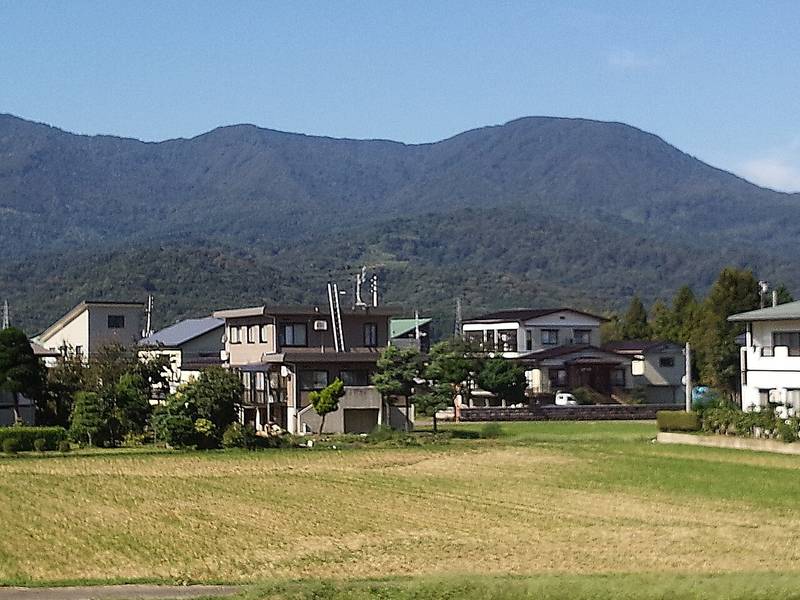
A medieval mountain castle known as the place where Uesugi Kagetora met his end during the Otate Rebellion (1578). There is no castle keep; remnants of a dirt castle such as dry moats, enclosures, and koguchi remain. Burnt rice was excavated from the rice storehouse ruins within the castle. National Historic Site. The stamp is located near the management building (general information center) of the Hita Prefectural Recreation Area. Please confirm the location and hours for stamping with the official source. About 2.5 km from Etsumi Toki Railway Myoko Haneuma Line Kita-Arai Station.

A flatland castle with origins in the Jinbo clan's era. No donjon was built during the Edo period; the current donjon is a mock castle built in 1954 and is open as the Toyama City Folk Museum (not an existing donjon). Highlights include the stone walls, moats, and the all-zelkova Chitoshi-mon gate. The castle ruins are developed as Toyama Castle Ruins Park. Stamps are available near the Toyama City Folk Museum (please confirm location and stamping hours with the official source). Take the streetcar from Toyama Station and alight at Kokusai Kaigijo-mae.
A continuous-style mountain castle, one of the largest in Etchu, with origins in the Nanboku-cho period. There is no keep, and the extensive remains of earthen castle structures such as enclosures, steep slopes, vertical moats, and moats are the main attraction. It is a National Historic Site. The stamp is located near the Tonami City Buried Cultural Properties Center "Shirushi" (confirm official sources for location and stamping hours). Access is primarily by car, with the destination near Tonami City Shoto Elementary School.
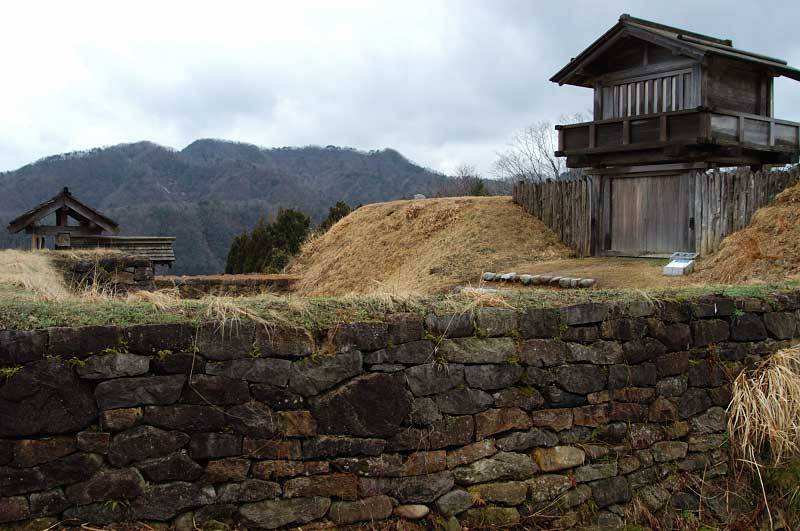
A mountain castle said to have been built by Suzuki Dewa-no-kami around the beginning of the Tensho era (c. 1573), it became the last stronghold of the Kaga Ikko-ikki. There is no castle keep; the reconstructed masugata gate, stone walls, earthworks, dry moats, and enclosures are highlights. National Historic Site (Torikoshi Castle Ruins,附 Nikuruma Castle Ruins). The stamp is located near the Torikoshi Ikko-ikki History Museum. Please confirm the location and hours for stamping with the official source. About 50 minutes by car from Hakusan IC.
A castle built by Yuki Hideyasu starting in 1601 through a nationwide construction project. The castle keep was destroyed by fire in 1669 and never rebuilt; only the castle keep base and the stone walls and moats of the Honmaru remain (only the castle keep base). The Fukui Prefectural Government building stands on the Honmaru ruins, and the reconstructed Ouroka Bridge and Yamashiroguchi Gate are also highlights. The stamp is located near the Fukui Prefectural Government building. Please confirm the location and hours for stamping with the official source. A few minutes walk from JR and Hokuriku Shinkansen Fukui Station.
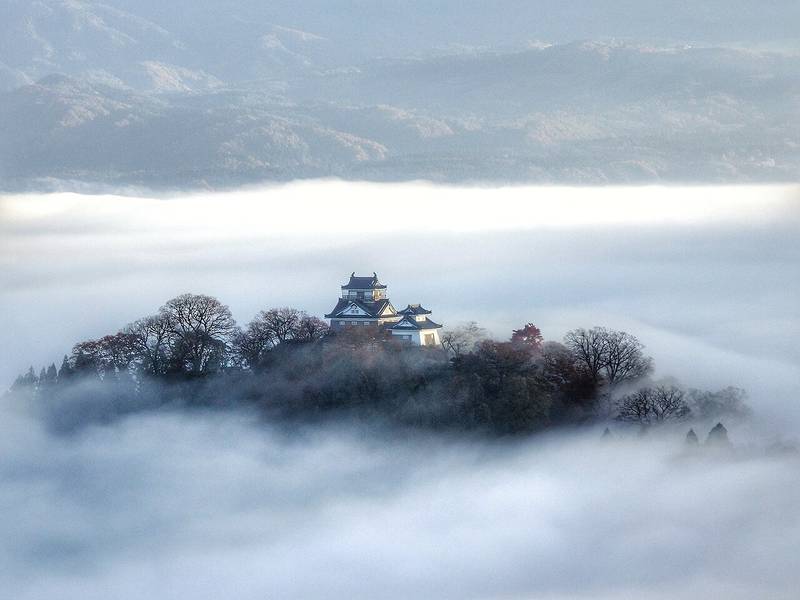
A flat-mountain castle built by Kanamori Nagachika during the Tensho era, known as the 'Castle in the Sky' floating on a sea of clouds from autumn to spring when conditions are right. The current donjon is a reconstruction from 1968 (not an existing donjon). Highlights include the stone walls on the mountaintop and the sea of clouds. It is a designated historic site of Fukui Prefecture. Stamps are available near the reception area inside Echizen Ono Castle (please confirm location and stamping hours with the official source). Approximately a 30-minute walk from Echizen-Ono Station on the JR Etsumi-Hoku Line.
A mountain castle said to have been renovated by Katsuhisa Aoya during the Koji era, known as an "impregnable castle" that repelled attacks from the Asakura army. There is no keep, and the highlights include the terraced enclosures, earthworks, stone walls, dry moats, and moats, as well as the remains of the residence at the foot of the mountain. It is a Mihama Town Designated Historic Site. The stamp is located near the Wakasa Kuniyoshi Castle History Museum at the foot of the mountain (confirm official sources for location and stamping hours). Approximately a 25-minute walk from JR Obama Line Mihama Station.
A dirt castle built on the ridge straddling the Fukui and Shiga prefectural border, where Shibata Katsuie's main camp was located during the Battle of Shizugatake in Tensho 11 (1583). There is no castle keep; the highlights are the multiple defenses of earthworks and dry moats, and the well-preserved layout including horse-shoe shaped enclosures (umadashi) and gate areas (koguchi), and earth bridges. National Historic Site. The stamp is located near the Genba-o Castle Ruins parking lot (may change in winter). Please confirm the location and hours for stamping with the official source. About 30 minutes by car from Hokuriku Expressway Tsuruga IC.
4. Tokai
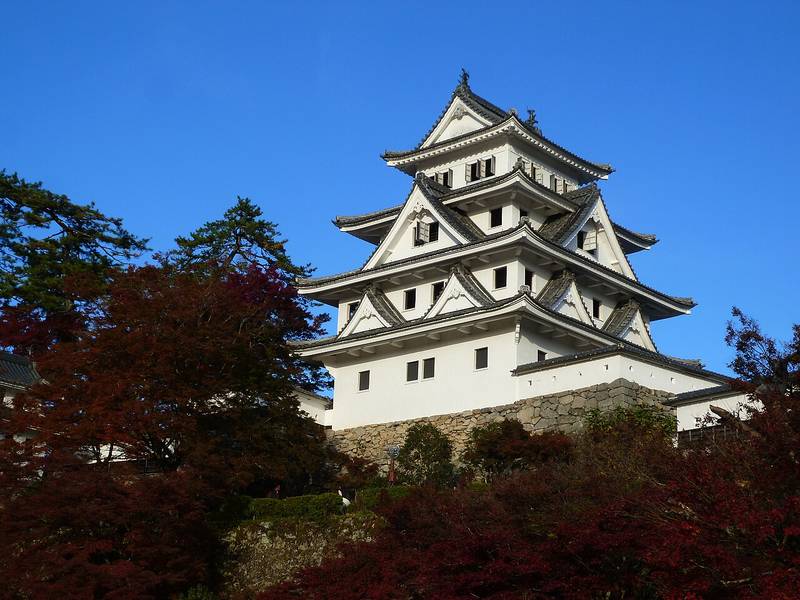
A mountain castle built on Mt. Hachiman at an altitude of about 350m. The mock castle keep, a four-story wooden structure, was rebuilt in 1933 based on Ogaki Castle and is said to be the oldest existing wooden reconstructed castle in Japan (not an existing castle keep). The stone walls of the castle ruins are a designated historic site of Gifu Prefecture, and the castle keep is a designated tangible cultural property of Gujo City. The view overlooking the castle town and the Yoshida River from the castle keep is a highlight. The stamp is located near the castle keep. Please confirm the location and hours for stamping with the official source. Nagaragawa Railway Gujo-Hachiman Station is the base.
A mountain castle built on a rocky mountain with continuous large rocks, which was the residence of the Toyama clan. There is no existing donjon; a suspended observation deck has been built on the donjon base incorporating large rocks. Designated a National Historic Site in 1981. Highlights include the large rocks like Umaarai-iwa and the stone walls, as well as the 360-degree panoramic view of the Kiso River and Mt. Ena from the observation deck. Stamps are available near the Naegi Toyama History Museum (please confirm location and stamping hours with the official source). Nakatsugawa Station on the JR Chuo Main Line is the nearest access point.
A mountain castle of the Oda-Toyotomi style built on Mt. Kojo, known as the residence of the Mori clan, including Yoshinari Mori and Ranmaru Mori. It was destroyed in 1601 after the Battle of Sekigahara, and no buildings such as the keep remain, but the stone walls from that time are largely intact. Designated a National Historic Site in 2013. The main gate's枡形 (masugata) and the view of Kani City from the main keep area are highlights. The stamp is located near the Kani City Tourism and Exchange Center (confirm official sources for location and stamping hours). A good base is Meitetsu Hiromi Line Akechi Station.
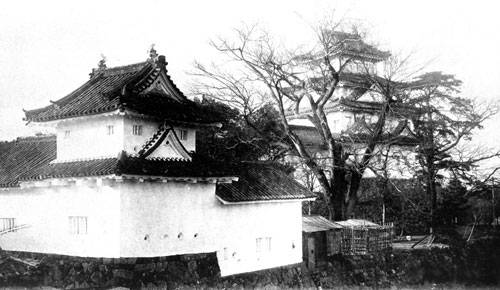
A flatland castle that served as the headquarters for Ishida Mitsunari and the Western Army in the Battle of Sekigahara. The former castle keep was designated a National Treasure in 1936 but was destroyed in the Ogaki air raid in 1945, and was rebuilt in 1959 as a four-story, five-tiered reconstruction (not an existing castle keep). The Ushitora Yagura (Northeast turret) has also been rebuilt. Designated Historic Site of Ogaki City. Highlights include the Honmaru stone walls, the moat along the Suimon River, and the exhibits within the castle keep related to the Battle of Sekigahara. The stamp is located inside the castle keep. Please confirm the location and hours for stamping with the official source. About a 7-minute walk from JR Ogaki Station.
A concentric flat-mountain castle known as the castle where Ise Shin Kurō Moritoki (Hojo Soun) raised his banner (dates of appointment are legendary). No castle keep was built, but remnants such as a large earthwork behind the Honmaru, a large dry moat over 20m wide, and the castle keep base remain. Designated a National Historic Site in 1995. The view of Suruga Bay from the castle keep base is a highlight. Stamps are located within the grounds of Homi Shrine and elsewhere. Please confirm the location and hours for stamping with the official source. JR Tokaido Main Line Hara Station is the base.
A mountain castle said to have been built in 1573 by Takeda Katsuyori, ordering his vassal Nobuharu Baba, and is an earthwork castle without a donjon. Designated a National Historic Site in 1975. Known for its well-preserved Takeda-style fortifications, including the round maru-boma and crescent-shaped moats. Highlights include the horizontal moats, masugata-kochi (gateways), and a reconstructed medicine gate. Stamps are available near the visitor center (please confirm location and stamping hours with the official source). Kanaya Station on the JR Tokaido Main Line is the nearest access point.
A medieval mountain castle that utilizes the terrain of Mt. Tsuru-o, famous as a stage for the battles between the Takeda clan and Ieyasu Tokugawa. It is an earthen castle composed of enclosures, moats, and earthworks, without stone walls, and has no keep. Designated a National Historic Site in 1975. The main keep area and other major enclosures, as well as the dry moats and moats, are highlights. The stamp is located at the Nishi-Otsuka Community Center, etc. (confirm official sources for location and stamping hours). A good base is to take a bus from JR Kakegawa Station and get off at Tsuchihashi.
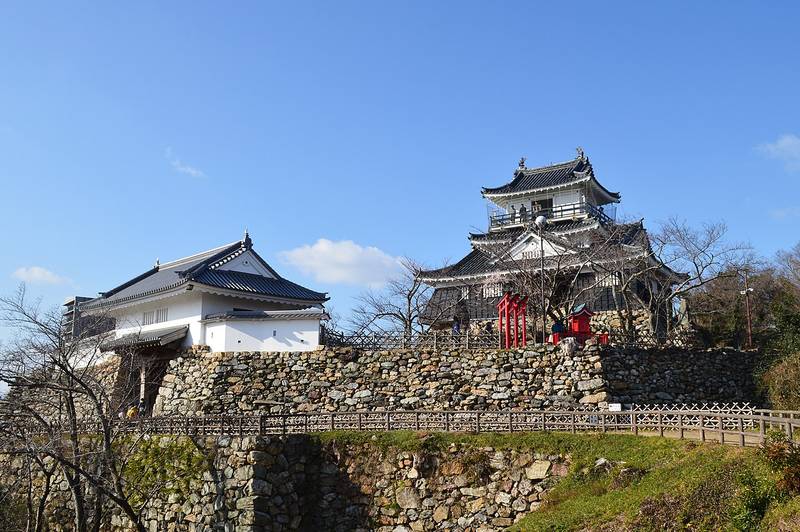
A castle that Tokugawa Ieyasu renovated from its predecessor, Hikuma Castle, it is called the "Castle of Success" because its successive lords achieved great success. The current castle keep is a reconstruction built in 1958 with reinforced concrete (also called a mock castle keep; not an existing castle keep). Designated Historic Site of Hamamatsu City. Highlights include the natural stone-built castle keep base (nozura-zumi) and the view from the castle keep. The stamp is located near the castle keep gate. Please confirm the location and hours for stamping with the official source. JR Hamamatsu Station is the base.
A flat-mountain castle built by Oda Nobunaga in 1563 after moving from Kiyosu, later renovated by Tokugawa Ieyasu for the Battle of Komaki and Nagakute. Designated a National Historic Site in 1927. Excavations revealed it was a castle with substantial stone construction, and the stone walls, enclosures, and earthworks are highlights. The Komakiyama History Museum on the summit is a mock castle keep unrelated to historical facts. Stamps are located at Rekishiru Komaki and other locations. Please confirm the location and hours for stamping with the official source. Meitetsu Komaki Line Komaki Station is the base.
A flat-mountain castle built as a base for the Takeda clan's invasion of Mikawa, said to have been designed by Nobuharu Baba. It is an earthwork castle without a donjon, consisting of earthworks, moats, and baileys. Designated a historic site of Shinshiro City in 2018. Highlights include well-preserved Takeda-style fortifications such as the double-sided masugata-kochi, large horikiri (moat cuts), bridges, and maru-boma. Stamps are available at the Sakute History and Folklore Museum (please confirm location and stamping hours with the official source). Convenient by bus to Sakute Takasato stop or by car.
A flat castle in Toyohashi Park, formerly Imahashi Castle built by Kobaku Maki. No actual keep was built. The iron turret (Kurogane-yagura) northwest of the main keep was a simulated reconstruction in 1954 and is now open as a museum. It is a Toyohashi City Designated Historic Site. Highlights include the stone walls, earthworks, moats, and the lower enclosure northwest of the main keep. Stamps are located at the iron turret and the Toyohashi City Hall observation deck (confirm official sources for location and stamping hours). From Toyohashi Station, take the city tram to Shiyakusho-mae.
A flatland castle with a concentric layout that Todo Takatora extensively renovated in 1608 after entering the castle. The current Mie Yagura (三重櫓) was built in 1958 as a mock turret and is not an accurate reconstruction of Takatora's era. Designated Historic Site of Mie Prefecture. Highlights include the stone walls, inner moat, castle keep base, the Japanese garden in the Honmaru, and the statue of Todo Takatora on horseback. The stamp is located at the adjacent Takayama Shrine. Please confirm the location and hours for stamping with the official source. About a 15-minute walk from Kintetsu Nagoya Line Tsu-Shimmachi Station.
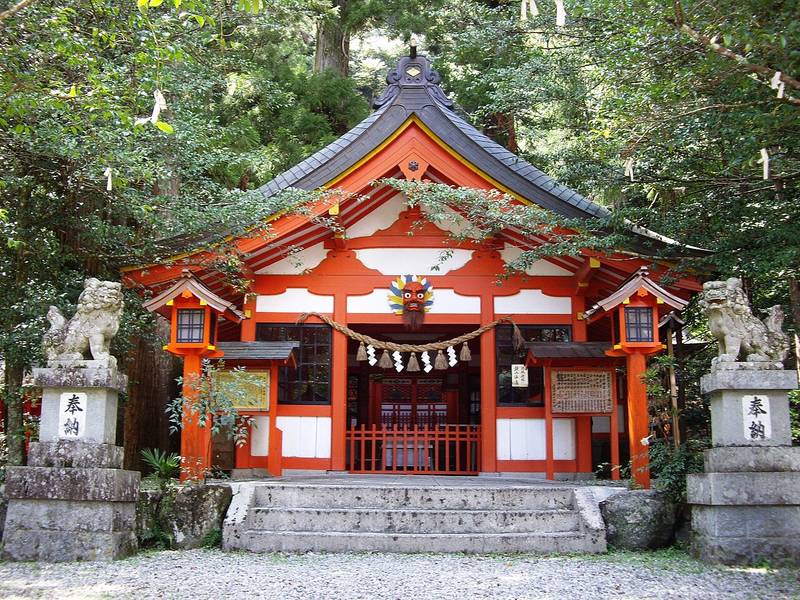
This is the site of the castle where the Kitabatake clan, the provincial governors of Ise Province, established their base after the Nanboku-cho period. The Kitabatake Shrine now stands on the former castle grounds. The site, including the Kiriyamajo Castle Ruins, a defensive castle, is designated as a National Historic Site. The Kitabatake clan's mansion garden, a samurai residence garden from the Muromachi period, is a National Place of Scenic Beauty. Highlights include the pond garden with Komeji Pond, the Kitabatake Shrine, and the Kiriyamajo Castle Ruins on the mountaintop. Stamps are available at the Kitabatake Shrine's office. Please confirm the location and stamping hours with the official source. JR Meisho Line's Hitsu Station and Ieki Station are the nearest access points.
A flat-mountain castle said to have been built by Chikafusa Kitabatake, and later a three-story donjon was built by Nobukatsu Oda. The donjon was destroyed by fire in 1580 and does not exist today; the castle ruins consist of the donjon base and stone walls. It is a designated historic site of Mie Prefecture. Highlights include the nozura-zumi (rough-hewn stone) walls, the donjon base, and moats/empty moats. Tamaki Junior High School is located within the castle grounds, which is also known as a cherry blossom viewing spot. Stamps are available at the Murayama Ryuhei Memorial Museum (please confirm location and stamping hours with the official source). Approximately a 10-minute walk from Tamaru Station on the JR Sangū Line.
Castle ruins designed by Takatora Todo, a hillside castle primarily featuring stone walls that combine medieval and early modern construction methods. No buildings such as the keep remain, but the enclosures, stone walls, moats, and earthworks are preserved as historical remains, and it is known as a "castle in the sky." Designated a National Historic Site in 1989 as "Akagi Castle Ruins and Tabirko Pass Execution Site." The main keep's枡形 (masugata) gate and the field-dressed stone walls are highlights. The stamp is located at the roadside station Kumano-Itaya Kurobe-no-Sato (confirm official sources for location and stamping hours). By car from JR Kumano City Station.
5. Kinki
A mountain castle ruins, said to be one of the largest in the Koto region, with a concentric layout. It is said to have been built by the Dohi clan. There are no existing or reconstructed castle keeps; remnants such as enclosures, large dry moats, stone walls, and masugata-koguchi remain. The site of the large turret confirmed by excavation is a highlight, and it was designated a National Historic Site in 2005. The stamp is located near Cafe & Gallery Gen'emon in the Bamba area (please confirm location and hours with official source). The base is JR Maibara Station.
A mountain castle built by Toyotomi Hidetsugu in 1585. There is no existing or reconstructed donjon; the castle ruins include a donjon base approximately 15 meters square, a keep surrounded by stone walls, and the high stone walls of Hidetsugu's residence. Access to the mountaintop is via the Hachiman-yama Ropeway. Highlights include the Mugumo Gosho Zuiryuji Temple on the summit and views of Hachiman-bori moat and the castle town. Stamps are located near the ropeway summit station (please confirm location and stamping hours with the official source). JR Omihachiman Station is the nearest access point.
A concentric-style flat-mountain castle built by Akechi Mitsuhide in 1579. The main and sub-donjons are external reconstructions from 1986 and not existing structures; the interior houses a local history museum. Highlights include the transferred stones used in the nozura-zumi stone walls, approximately 500 five-ring stupas and stone Buddhas, and the deep well 'Toyoiwa-i.' The stone walls are a designated historic site of the city. Stamps are available near the donjon entrance (please confirm location and stamping hours with the official source). Fukuchiyama Station on the JR and Kyoto Tango Railway is the nearest access point.
A continuous-style mountain castle that was temporarily the residence of Nagayoshi Miyoshi. It is said to have been built by Takakuni Hosokawa, and Nagayoshi used it as his base from around 1553 until he moved to Iimori Castle. There is no keep, and the ruins, including the enclosure group, stone wall remains, earthworks, and moats, are preserved. The view of the Osaka Plain from the summit of Mt. Miyoshi is a highlight. Designated a National Historic Site in 2022 as "Akutagawa Castle Ruins." The stamp is located near the Shiaro Rekishi-kan (History Museum) in Takatsuki City (confirm official sources for location and stamping hours). The base is JR Takatsuki Station.
A large mountain castle that Miyoshi Nagayoshi used as his base for controlling the Kinai region. Spanning Daito City and Shijonawate City on Mt. Imori, this castle ruin has over 70 enclosures with rare stone walls for a mountain castle, as well as remnants like vertical moats and dry moats, but no castle keep. The view from the summit is a highlight. It was designated a National Historic Site in 2021. The stamp is located near the Shijonawate City Museum of History and Folklore (please confirm location and hours with official source). The base is JR Shijonawate Station and Nozaki Station.
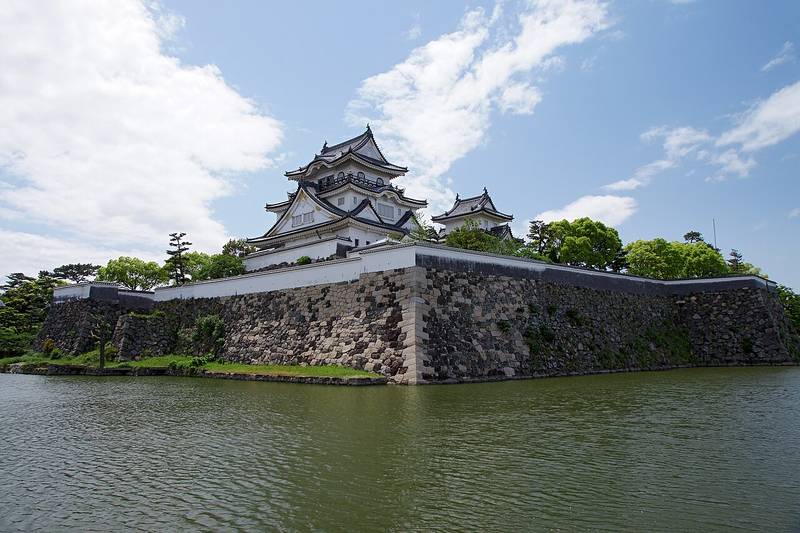
A concentric-style flatland castle. The three-story donjon is a reconstruction from 1954 and not an original existing structure; the original five-story donjon was lost to fire during the Edo period. The interior houses a museum. Highlights include the dry landscape garden 'Hachin-no-niwa' designed by Mirei Shigemori, a National Place of Scenic Beauty, and the stone walls and moats with walkways. The castle ruins are a Prefectural Historic Site of Osaka. Stamps are located near the Ninomaru Hiroba Tourist Exchange Center (please confirm location and stamping hours with the official source). Takochi-cho Station on the Nankai Main Line is the nearest access point.
A general term for Izushi Castle (flat-mountain castle) at the foot of the mountain and Ariko-yama Castle (mountain castle) on the summit. Izushi Castle was built by Yoshihide Koide in 1604 and has no donjon; reconstructed corner turrets and the main gate, along with nozura-zumi stone walls, remain. Ariko-yama Castle, built by Suketoyo Yamana in 1574, has remaining stone walls and a large moat, and together with Sumiyama Castle Ruins, is designated a National Historic Site as 'Yamana Clan Castle Ruins.' The Tatsunokoro clock tower in the castle town is also nearby. Stamps are available near the Izushi Tourist Center (please confirm location and stamping hours with the official source). Accessible by bus from JR Toyooka Station.
A mountain castle of connected terraces, said to have been built by Akamatsu Sadanori. Also known as Bōgetsu-jō. It is known as the castle of Akai (Ogino) Naomasa, the "Red Ogre of Tanba," and was the stage for Akechi Mitsuhide's invasion of Tanba. It has no keep, but the castle ruins with stone walls, earthworks, moats, and terraces surrounding the main keep remain, with cloud seas and summit views as highlights. Designated a National Historic Site in 1989. The stamp is located near the Kasuga Community Center (please confirm location and hours with the official source). The base is JR Kuroi Station.
One of the largest castles on Awaji Island, connecting a mountain-top castle (mountain castle) and a foothills castle (flat castle) with climbing stone walls. It is said to have been built by the Ataka clan, and Wakisaka Yasuharu extensively renovated it into an all-stone wall structure. The current keep on the keep platform is a replica built in the early Showa period and is said to be one of the oldest in Japan (not an existing keep). Highlights include the existing climbing stone walls and the view from the keep platform. The upper castle is a National Historic Site. The stamp is located near the Awaji Culture History Museum in the lower castle (please confirm location and hours with the official source). The base is Sumoto Bus Center.
A concentric-style flat mountain castle renovated by Tsutsui Junkei and greatly expanded by Toyotomi Hidenaga. The castle keep does not exist today, but the castle keep base has been developed as an observation facility, and the Otemon gate and turrets were restored in the 1980s. The inner moat, stone walls, and repurposed stones such as the 'Sakasa Jizo' are highlights, and it is also known as a famous spot for cherry blossoms. Designated as a national historic site in 2022. Stamps are placed near the Yanagisawa Bunko (check officially for placement and hours). The base is near Kintetsu Koriyama Station and JR Koriyama Station.
A mountain castle said to have been built by the Akiyama clan, with an unknown exact construction date. It is a castle ruin destroyed after the Summer Siege of Osaka, with no castle keep. Remnants such as the stone walls of the Honmaru and Tenshukaku, and moats remain. The castle town of Matsuyama is an Important Preservation District for Groups of Traditional Buildings. Designated as a national historic site in 2006. Stamps are placed at the Matsuyama Machikado Lab and Michi-no-Eki Uda Road (check officially for placement and hours). The base for climbing is the Machikado Lab.
A flat mountain castle built by Asano Tadayoshi in 1602 and later completed by the Mizuno clan. Also known as Tsuru Castle. The keep does not exist, but the castle ruins with cut-stone and embedded stone walls, a keep platform, a masugata-style entrance, and the Mizunote remains on Tsuru Mountain remain. The view overlooking the Kumano River is a highlight, and it is designated as a National Historic Site as "Shingu Castle Ruins and Mizuno Family Tomb." The stamp is located near the Shingu City Museum of History and Folklore (please confirm location and hours with the official source). The base is JR Shingu Station.
6. Chugoku
Wakasakioni Castle is a connected terrace mountain castle in Wakasa Town, Tottori Prefecture. The keep does not exist, but remains such as terraces, stone walls, entrances, vertical moats, and turret bases remain. It is valuable for its mixture of medieval and early modern castle ruins, and is also known for its hexagonal stone walls. It is a National Historic Site (designated in 2008). Highlights include the view from the summit and the stone wall complex. The stamp is located around Wakasa Station (please confirm location and hours with the official source). About a 16-minute walk from Wakasa Railway Wakasa Station.
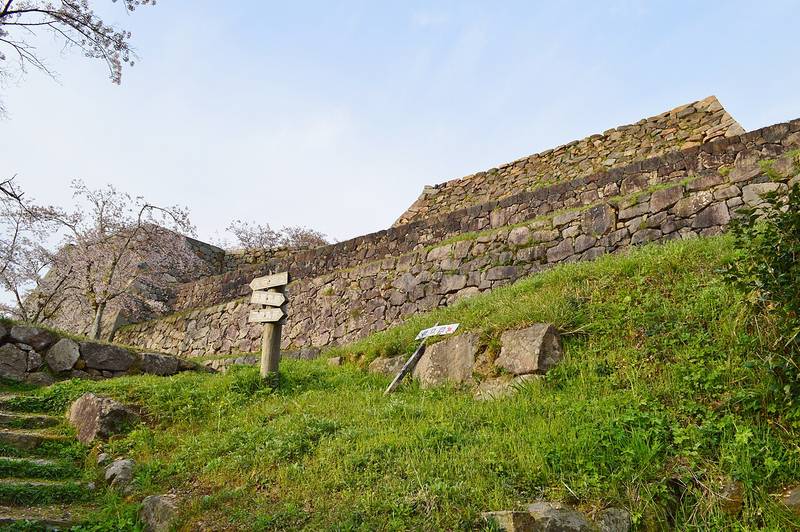
Yonago Castle is a tiered flat mountain castle (sea castle) in Yonago City, Tottori Prefecture. Although the castle keep does not exist today, magnificent stone walls and two castle keep bases of different sizes remain. Developed as a castle town by the Yamana clan, then by Yoshikawa Hiroie and Nakamura Kazutada in the early modern period. It is a national historic site (designated in 2006). The view of Nakaumi and Mt. Daisen from the castle keep base and the ascending stone walls are highlights. Stamps are placed around the castle ruins (check officially for placement and hours). Minatozan Park is the base from JR Yonago Station.
Hamada Castle is a flat mountain castle built on Mt. Kame (approx. 68m above sea level) in Hamada City, Shimane Prefecture, and served as the administrative center of the Hamada Domain. It was built by Furuta Shigeharu in 1620 and self-destructed during the Second Chōshū Expedition in 1866. The castle keep does not exist today, but stone walls remain, and it is a famous spot for cherry blossoms. It is No. 170 of the '100 Fine Castles of Japan'. The stone walls and the view are highlights. Stamps are placed at the Hamada Gokokujinja Shrine office and the Hamada Castle Museum (check officially for placement and hours). About a 20-minute walk from Hamada Station on JR.
Bitchu Takamatsu Castle is a tiered flat castle in Okayama City, known for its siege by Hashiba Hideyoshi in 1582, and surrendered when its lord, Shimizu Muneharu, committed seppuku. It has no keep, but the ruins of the main keep (Muneharu's head mound) and part of the siege embankment remain. It is a National Historic Site, "Takamatsu Castle Ruins and Siege Embankment Ruins." The castle park and Bitchu Takamatsu Castle Ruins Museum are highlights. The stamp is located near the museum (please confirm location and hours with the official source). About a 10-minute walk from JR Momotaro Line Bitchu Takamatsu Station.
Mihara Castle is a flat castle (coastal castle) in Mihara City, Hiroshima Prefecture, also known as Ukijo (Floating Castle). It was built by Kobayakawa Takakage around 1567. The keep does not exist, but stone walls and moats remain, and the keep platform is integrated with JR Mihara Station. It is a National Historic Site (Kobayakawa Clan Castle Ruins). The stone walls of the keep platform, visible from the station, are a highlight. The stamp is located around Mihara Station (please confirm location and hours with the official source). JR Mihara Station is the base.
Niitakayama Castle is a mountain castle (approx. 197.6m above sea level) in Hongō-chō, Mihara City, Hiroshima Prefecture. In 1552, Kobayakawa Takakage moved his base from Takayama Castle and developed it. There is no castle keep, but remnants such as stone walls, moats, earthworks, wells, and foundation stones remain. It is a national historic site (Kobayakawa clan castle ruins). It was abandoned with the construction of Mihara Castle in 1596. The masugata earthwork of the Honmaru and the view are highlights. Stamps are placed near the foot of the mountain (check officially for placement and hours). From Hongō Station on the JR Sanyo Main Line to the trailhead.

The Ōuchi Clan Residence was the residence of the Ōuchi clan in Yamaguchi City, now part of the grounds of Ryūfuku-ji Temple, with a restored west gate, garden, and stone-lined ditches remaining. The mountain castle of Takamine Castle behind it served as a stronghold; it was built by Ōuchi Yoshinaga in 1556, and stone walls and enclosures remain. Both are national historic sites, 'Ōuchi Clan Ruins'. The garden and the stone walls of Takamine Castle are highlights. Stamps are placed at the Ōji Lobby and Yamaguchi City Museum of History and Folklore (check officially for placement and hours). The JR Yamaguchi Line is the base.
7. Shikoku
The stronghold of the Miyoshi clan, who ruled Awa (Tokushima), this is a flat castle/residence without a keep. Miyoshi Jikkyū made it his base in the mid-16th century, and it became the center of regional control thereafter. Highlights include the excavated residence ruins, dry landscape garden remains, water moats, and earthworks. It is a National Historic Site. The stamp is located around the castle ruins; please confirm location and hours with the official source. Access is about a 10-minute walk from JR Kotoku Line Katsuzui Station.
A mountain castle boasting one of the largest scales in Awa (Tokushima), it has no keep, but remains of stone walls, terraces, and moats are left. It is said to have been built by Osakabe Nagamune during the Nanboku-cho period. Highlights include the main keep's stone walls reaching 5 meters high, the terraces such as Saizōmaru, Myōjinmaru, and Okuramaru, and the moats and vertical moats. It is a Tokushima Prefectural Historic Site. The stamp is located around the castle ruins (near Ichinomiya Shrine); please confirm location and hours with the official source. Ichinomiya Shrine is the base for the ascent, and it is about a 30-minute walk to the main keep.
A castle ruin (flat mountain castle) built on a peninsula jutting out into the Seto Inland Sea, characterized by its stone walls facing the sea. There is no castle keep. It is said to have been the residence of Shinomiya Ukon in the late Muromachi period. The stone walls remaining around the north and west turrets, the view of the Seto Inland Sea, and the castle enclosures on the ridge are highlights. Designated as a national historic site in 2020. Stamps are placed around the castle ruins; check officially for placement and hours. Access is about a 20-minute walk from Hiketa Station on the JR Takamatsu Line.
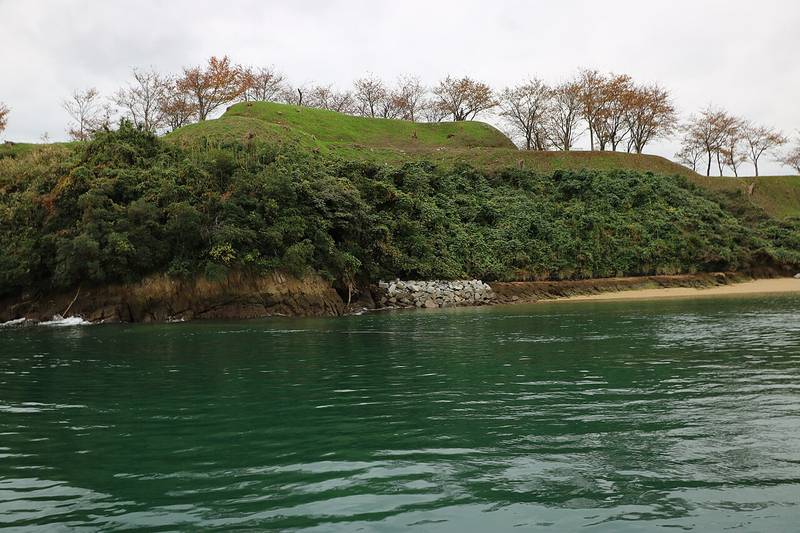
A sea castle of the Murakami pirates (Nōshima Murakami clan), with the entire uninhabited island of Nōshima in the Geiyo Islands serving as the castle grounds. There is no castle keep. The turbulent currents of the Miyakubo Strait itself served as a natural defense. Remnants of castle enclosures such as Honmaru, Ninomaru, and Sannomaru, and the rapid currents surrounding the island are highlights. It is a national historic site. Stamps are placed around related facilities; check officially for placement and hours. Access to the island is by boat; check officially for landing availability and tidal current cruises.
A mountain castle built on a hill surrounded by a river, it has no keep, but parts of the gate and buildings have been restored based on excavation surveys. It is said to have been built as a castle of the Watanabe clan in the medieval period. Highlights include the horseshoe-shaped terraces of the old castle, main castle, and new castle, double continuous moats, restored buildings, and views from the hilltop. It is a National Historic Site. The stamp is located within the castle ruins; please confirm location and hours with the official source. The nearest station is JR Yodo Line Matsumaru Station, about a walk away.
The stronghold of the Chosokabe clan, who almost unified Shikoku during the Sengoku period, this is a connected terrace mountain castle (castle ruins) without a keep. Terraces such as Tsume, Ni-no-dan, and San-no-dan are connected on Okoyōyama, with earthworks, dry moats, stone walls, and a well site remaining. Highlights include the Kochi Prefectural Museum of History and Folklore adjacent to the castle ruins, the terraces, and the view. It is a National Historic Site. The stamp is located around the museum (please confirm location and hours with the official source). Access by bus from JR Kochi Station.
8. Kyushu/Okinawa
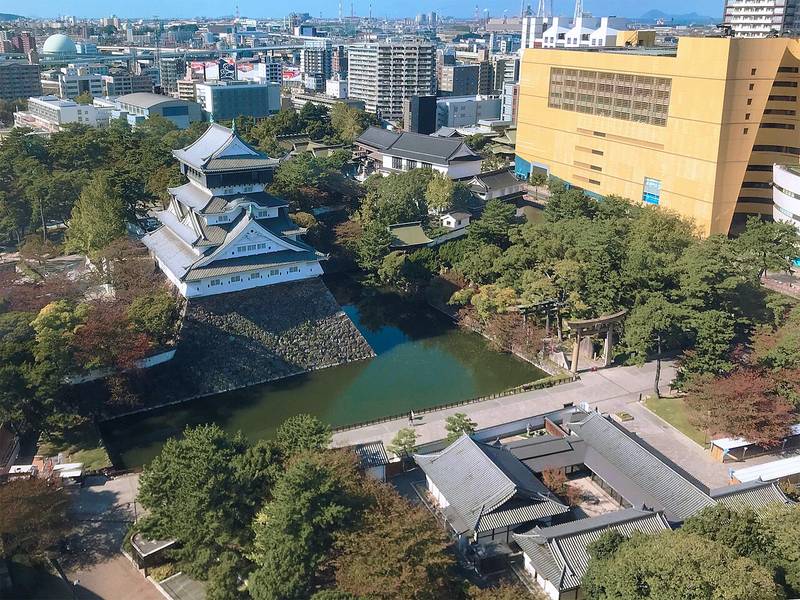
A flat castle (sea castle) that Hosokawa Tadaoki extensively rebuilt from an existing castle starting in Keicho 7 (1602). The castle keep, characterized by its 'Karazukuri' style without eaves between the fourth and fifth floors, was destroyed by fire in Tenpo 8 (1837), and the current castle keep is a reconstruction from Showa 34 (1959). Stone walls built with Namazumi and moats remain. Stamps are placed near the castle keep (check officially for placement and hours). About a 10-minute walk from Nishi-Kokura Station on JR.
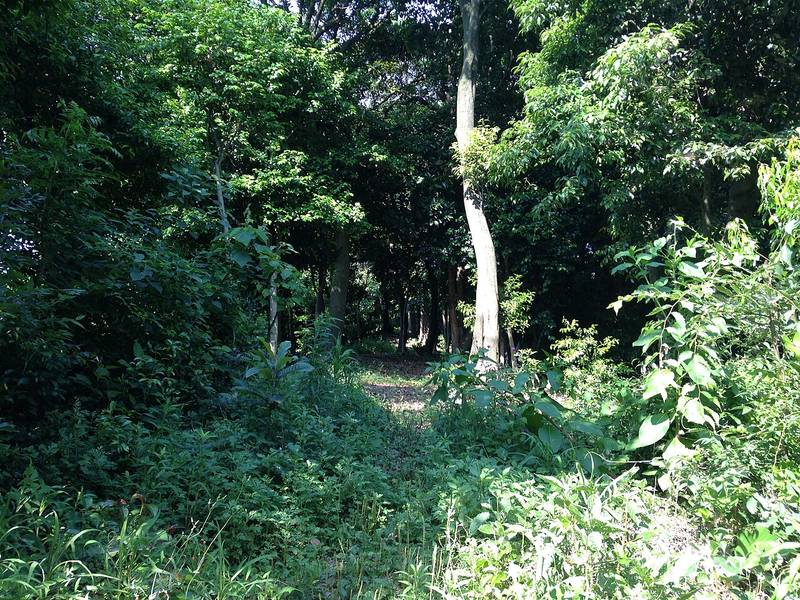
A defensive barrier built in 664 AD by the Yamato court to defend Dazaifu after the defeat at the Battle of Baekgang. This massive earthwork, approximately 1.2 km long and with a base width of about 80 m, and an outer moat, blocked the plain. It is a national special historic site, 'Mizuki Castle Ruins'. The earthwork, castle gate ruins, and reconstructed wooden flume are highlights. Please check officially for stamp placement and hours. The vicinity of Mizuki Station on the JR Kagoshima Main Line is the closest (check officially for transportation).
A connected terrace flat mountain castle with origins in the Eisho era, it became the residence of the 210,000 koku Arima clan of Settsu from 1621 until the Meiji Restoration when Arima Toyouji entered the domain. It did not have a keep, but a three-story巽櫓 (Tatsumi Yagura) was used as a substitute. It is a Fukuoka Prefectural Historic Site. Highlights include the high turret stone walls surrounding the main keep, moats, and a large well. Please confirm stamp location and hours with the official source. Access from JR Kurume Station (details to be confirmed with official source).
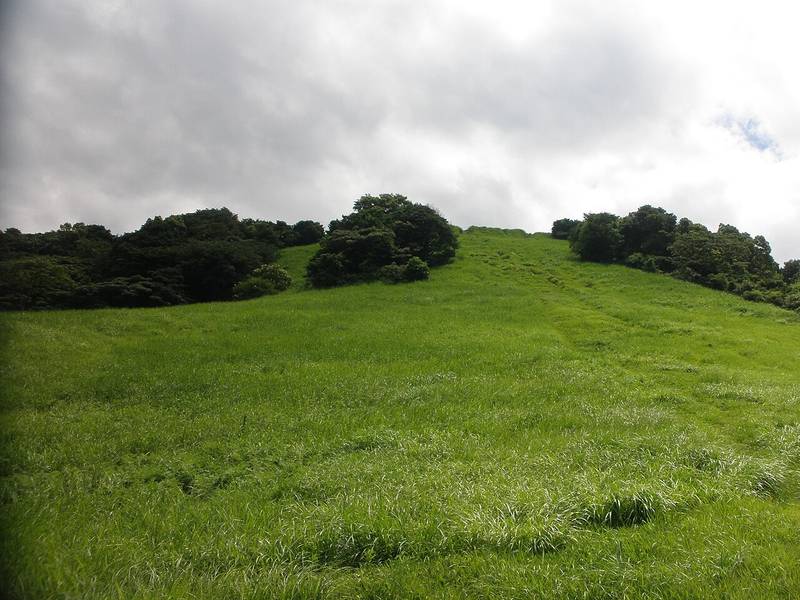
An ancient Korean-style mountain castle built by the Yamato court in 665 AD after the defeat at the Battle of Baekgang, under the guidance of exiled Baekje people, making it one of the oldest in Japan after the Mizuki built in 664. It has approximately 3.9 km of castle walls encircling Mt. Kiyoi at an altitude of 404m. It is a National Special Historic Site, "Kiyoi Castle Ruins." Remains of water gates and castle gates are left, and you can see Hakata Bay and the Ariake Sea from the summit. Please confirm stamp location and hours with the official source. JR Kiyama Station is the starting point.
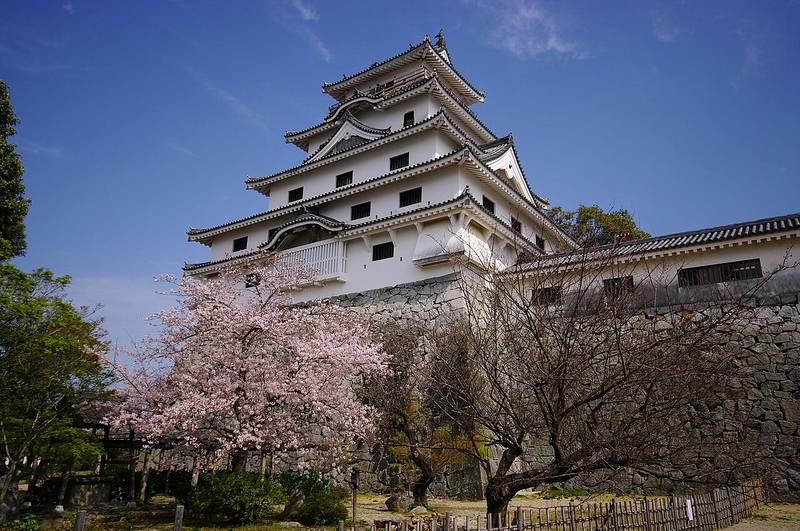
A flat mountain castle facing the sea, built by Terazawa Hirotaka over 7 years starting in Keicho 7 (1602). It is known by its alternate name 'Maizuru Castle', with the castle keep resembling a crane's head and the pine groves on either side resembling wings. The current castle keep, lacking contemporary drawings, was built in 1966 as a mock castle with a望楼型 (bouro-gata) style. It is a Karatsu City designated historic site. The stone walls and the view of Nijinomatsubara are highlights. Please check officially for stamp placement and hours. About a 15-minute walk from Karatsu Station on JR.
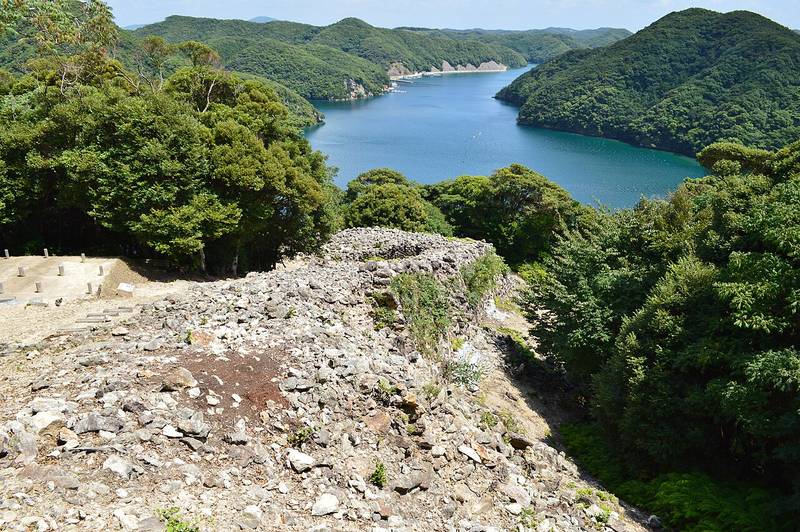
An ancient mountain castle built by the Yamato court in 667 in Tsushima to prepare for invasions by Tang and Silla after the defeat at the Battle of Baekgang. It is characterized by stone walls of quartz porphyry encircling Mt. Shiro, with remnants of Ichino-, Ni-, and Sanno-kido (castle gates). A National Special Historic Site "Kaneda Castle Ruins." The summit offers a panoramic view of Asō Bay. Confirm location and stamping hours for stamps with the official source. Tsushima is an island, so transportation from the airport/port should be confirmed with the official source.
A late Edo period coastal castle, also known as Ishida Castle, built by the Goto clan (Fukue Domain) with permission obtained in 1849 and completed in 1863, in preparation for the arrival of the black ships. No keep was built. The circuit garden in the second bailey is a National Place of Scenic Beauty, "Ishida Castle Goto Clan Garden," and the castle ruins are a Nagasaki Prefectural Historic Site, with unworked stone walls and the existing Kede-mon gate remaining. Please confirm stamp location and hours with the official source. Goto Island is a remote island (transportation to be confirmed with official source).
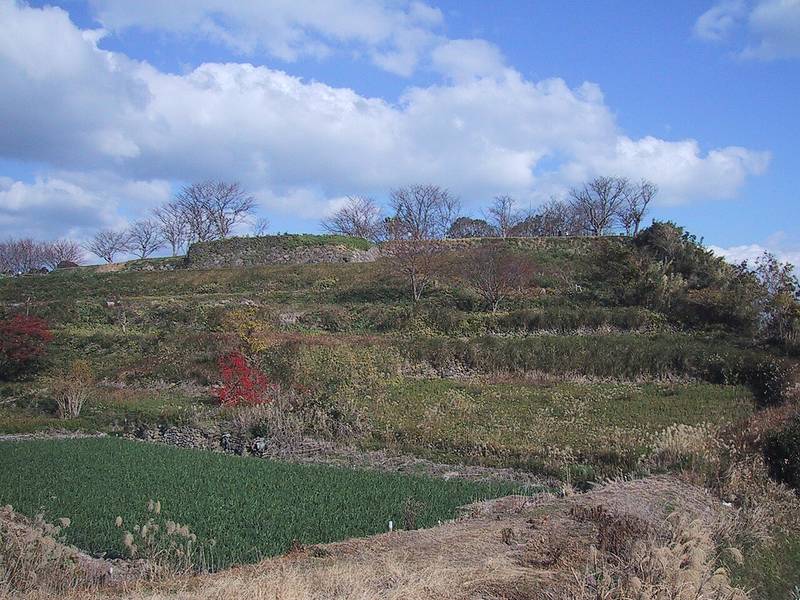
A flat mountain castle built by the Arima clan in the Meiō era and developed by Arima Harunobu. After being abolished in 1616, it is known as the main battlefield where the rebel forces, supporting Amakusa Shirō, were besieged during the Shimabara-Amakusa Rebellion in 1637-1638. It is a National Historic Site, "Hara Castle Ruins," and a component of the World Heritage site "Hidden Christian Sites in the Nagasaki Region." Remains of terraces and stone walls, and views of the Ariake Sea remain. Please confirm stamp location and hours with the official source.
A mountain castle built in the late 7th century after the defeat at the Battle of Baekgang, serving as a support base for the Yamato court to supply food and weapons to Onojō, Kii Castle, Kaneda Castle, etc. It is a national historic site, 'Kikuchi Castle Ruins'. Highlights include the reconstructed drum tower based on the only octagonal building ruins among ancient mountain castles, reconstructed buildings such as granaries and barracks, rammed earthworks, and reservoir sites, with a guidance facility 'Onko Sōseikan'. Please check officially for stamp placement and hours. Kiku-ka-chō, Yamaga City (check officially for transportation).

A flat castle built in 1622 by Tadahiro Kato, lord of Kumamoto Domain, as a special exception to the "One Castle per Province" decree, replacing Mashikijima Castle which collapsed in an earthquake in 1619. The castle lord changed from the Kato clan to the Hosokawa clan, then to the Matsui clan. The donjon was destroyed by lightning in 1672 and not rebuilt, leaving the donjon base, stone walls, and water moat. A National Historic Site "Yatsushiro Castle Ruins Group," including Furukōri Castle and Mashikijima Castle. Yatsushiro Shrine stands in the main keep. Confirm location and stamping hours for stamps with the official source. JR Yatsushiro Station is the starting point.
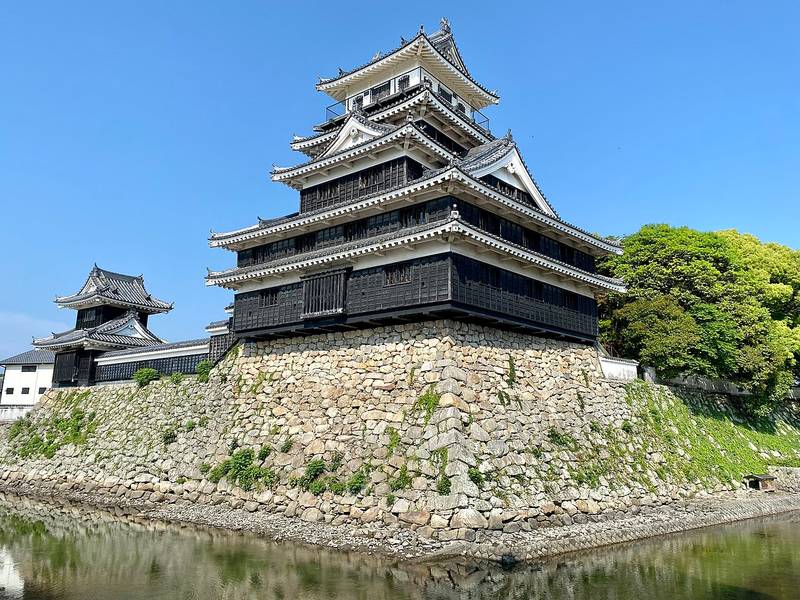
A flat castle that Kuroda Yoshitaka (Kanbei) began building in 1588 and was later completed by Hosokawa Tadaoki. It is counted as one of Japan's three great water castles due to its structure of drawing seawater into the moat. The current keep is a replica built in 1964. It is an Oita Prefectural Historic Site. Highlights include the stone walls, said to be the oldest in Kyushu from the Kuroda era, and the seawater moat. Please confirm stamp location and hours with the official source. About a 15-minute walk from JR Nakatsu Station.
A mountain castle said to have been built by the Mori clan during the Kamakura period, and developed into a castle town by Mori Takamasa during the Bunroku-Keicho era. It is a national historic site, 'Kakumure Castle Ruins'. The stone walls built with Anō-style masonry (Namazumi) remaining at the presumed Karamate Gate ruins are a highlight, and remnants such as the castle enclosures, earthworks, vertical moats, and well sites are well-preserved. Please check officially for stamp placement and hours. Access by bus from Bungomori Station on the JR Kyudai Line (check officially for transportation details).
A sea castle built by Ōtomo Sōrin in 1562 on Nyuujima, a tombolo, formerly known as Nyuujima Castle. Although the castle keep does not exist today, two turrets remain: the Tatami-yagura in the Ninomaru and the Uotora-guchi Kaki-yagura in the Honmaru. The Daimon-yagura was restored in wood in 2001. It is a national historic site, 'Usuki Castle Ruins'. The stone walls, dry moats, and the unique terrain of an island castle are highlights. Please check officially for stamp placement and hours. About a 10-minute walk from Usuki Station on JR.
A mountain castle built by Takamasa Mōri on the summit of Mt. Hachiman in 1606. The main bailey on the summit is surrounded by total stone walls, and the only existing structure at the foot of the mountain, the Sannomaru Yagura Mon (built in 1832), remains. A National Historic Site. Highlights include the dry moat separating the main keep and the second keep, and the view from the summit. Confirm location and stamping hours for stamps with the official source. JR Saiki Station is the starting point (confirm climbing details with official source).
A flat mountain castle started by Takahashi Mototane in 1601 and completed in 1603. The high stone walls of the second bailey are called the "Thousand Killer Stone Walls" due to the legend that if the key stones were removed, many enemies would fall. There is no keep, and the three-story turret, equivalent to a keep, was not rebuilt after being burned down. It is a Nobeoka City Historic Site. The bell tower that still tells the time remains on the keep platform. Please confirm stamp location and hours with the official source. About a 20-minute walk from JR Nobeoka Station.
A mountain castle built in the medieval period, with lords such as the Ito clan and Shimazu clan (there are various theories about the construction period). Although the site of the castle keep and gold-leaf tiles were found during excavation, the castle keep building does not remain. At the foot of the mountain, the Ninomaru palace 'Tsurumatsukan' has been restored in wood. It is a national historic site, 'Sadowara Castle Ruins'. Remnants of a medieval mountain castle, such as castle enclosures and dry moats, are highlights. Please check officially for stamp placement and hours. Access by bus or taxi from Sadowara Station on JR (check officially for transportation details).
A medieval mountain castle said to have been developed from the Nanboku-chō period, consisting of Uchijiro, Matsuo Castle, etc. (the builder is unclear). The layout, utilizing the topography of the tuff plateau, is characterized by six castle enclosures separated by deep dry moats. It is a national historic site, 'Shibushi Castle Ruins'. Remnants of medieval mountain castles such as earthworks, ko-guchi (entrances), and moats are well-preserved. Please check officially for stamp placement and hours. About a 22-minute walk from Shibushi Station on the JR Nichinan Line.
A medieval mountain castle built utilizing a tuff plateau. It is characterized by a vast layout where baileys other than the main keep are surrounded by deep dry moats, incorporating natural valleys as moats, and Chinese ceramics have been excavated. A National Historic Site "Chiran Castle Ruins." Highlights include the magnificent dry moats carved into the plateau and the baileys. Confirm location and stamping hours for stamps with the official source. From Kagoshima Chuo Station, take a Kagoshima Kotsu bus to "Nakagōri" stop, then walk (confirm transportation details with official source).
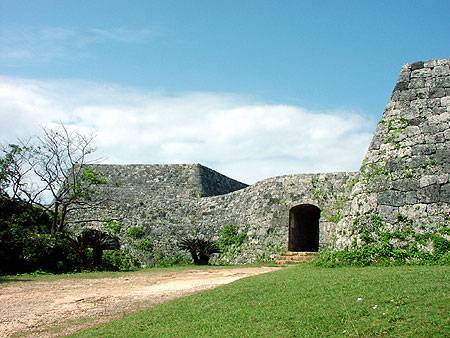
A Gusuku (castle) built by Gosamaru, an Aji of the Ryukyu Kingdom, around 1416-1422. The gently curving castle walls and the ancient-style arched gate using wedge stones are beautiful. It is a National Historic Site and a component of the World Heritage site "Gusuku Sites and Related Properties of the Kingdom of Ryukyu," the "Zakimi Castle Ruins." From the top of the castle walls, you can see the entire Yomitan area, the sea, and the surrounding islands. The Yuntanza Museum is adjacent. Please confirm stamp location and hours with the official source. Access by bus from Naha (transportation to be confirmed with official source).
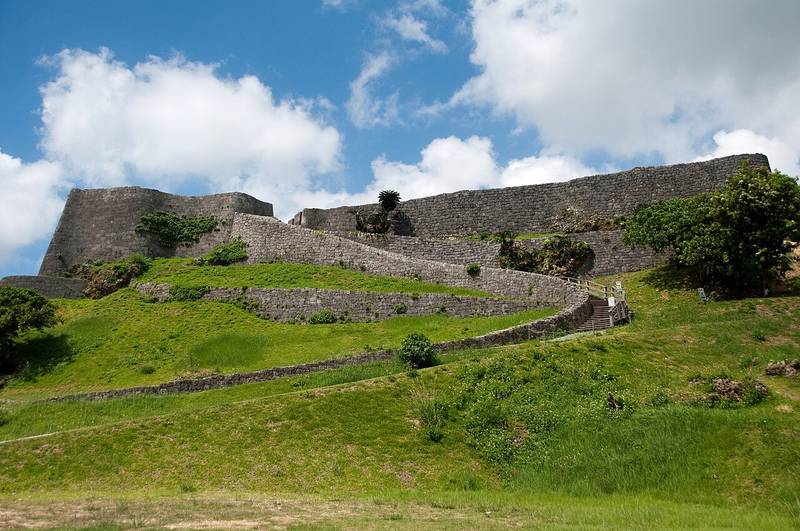
A Gusuku (castle) said to have been built in the early 14th century, known for being abandoned after its 10th lord, Amawari, was defeated by the Ryukyu Kingdom's army. It is a national historic site and a component of the World Heritage site 'Gusuku Sites and Related Properties of the Kingdom of Ryukyu', the 'Katsuren Castle Ruins'. Three castle enclosures arranged in tiers and stone walls remain, and the Ichinomaru at the highest point offers a panoramic view of the sea and surrounding area. Please check officially for stamp placement and hours. Access by bus from Naha to 'Katsuren Castle Ruins Entrance' (check officially for transportation details).
Related lists
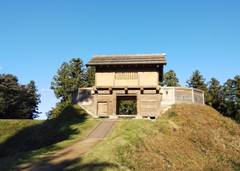
100 Famous Japanese Castles Stamp Rally
A list of the '100 Famous Japanese Castles' selected by the Japanese Castle Foundation in 2006 and for which a stamp rally has been held since June 2, 2007, organized by region. It covers famous castles nationwide, from Hokkaido to Okinawa, including the 12 existing castles such as Himeji Castle, Matsumoto Castle, and Hikone Castle, as well as Goryokaku Fort, Shuri Castle, and Takeda Castle Ruins. Stamps for each castle are located at the management office, entrance, etc., but their locations, stamping hours, and fees may change, so always check the official sources (Japanese Castle Foundation / each castle) for the latest information. You can view all 100 castles on a map and record 'how many castles you have conquered' by checking in.
100SO
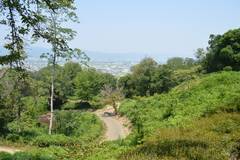
Tour of Special Historic Sites: 66 Selected Sites Designated by the Agency for Cultural Affairs
Special historic sites are the most representative historic sites in Japan, designated by the Agency for Cultural Affairs as having particularly high value among nationally designated historic sites. We have compiled a total of 66 sites, including Goryokaku Ruins, Sannai Maruyama Site, Toro Ruins, Himeji Castle Ruins, Heijo Palace Site, and Kumamoto Castle Ruins, in regional order. Please use this for planning your historical journey visiting castle ruins, ancient sites, and burial mounds.
66SO
Check off the places you visitand keep photos and notes.
Edit it however you like.
Sign up freeStart with your Google accountGet started right away, free